El trigal Ranch
El trigal is a 600 acre ranch 30 minutes east of Tallahassee which specializes in Texas Longhorn and Wagyu with a goal of creating the American Wagyu Super Beef Program. All of our cows are hormone and antibiotic free, raised ‘humanly’ in wide open pastures. Explore our website to learn why we carry the healthiest meat based on science.
Pricing
To Purchase Beef Call Bobby Floyd:
(850) 597-3751
Email wrbobbyfloyd@gmail.com
PO Box 2, Lamont, Florida, 32336
The El trigal Mission
Our objective for 34 years has been to produce the Healthiest Beef Possible for People who love beef but have concerns as to how Commercial Beef is being Produced and Processed.
To accomplish this, we stopped bringing mature cattle to El trigal, stopped vaccinating calves, using antibiotics, purchased future Herd Sires as yearlings, and AI ed some of our top cows to produce new herd sires. “{The most important factor in producing the healthiest Type Beef generation after generation is the Purity of the Parent Cattles’ genetics.}” The Texas Longhorn Cattle we use in our Beef Program are WR Branded cattle from the Wichita Wildlife Program, US branded cattle, Yates Cattle, and descendants from Marks cattle.
About El trigal Ranch
El trigal Ranch has the earliest and most unique recorded history of any Ranch in the United States of America.
In began in 1539 when Hernando de Soto, the first European to lead an expedition deep into interior of North America, approached the Aucilla River. The Aucilla River was the eastern boundary of the lands of the Apalachee Nation.
When Hernando de Soto and his men attempted to cross the Aucilla River they were met with great resistance from the Apalachee Natives, forcing them to cross this river in three separate locations.
One crossing was just south of US Hwy 27, the second crossing was on what would become El trigal Ranch, and the third crossing was south of El trigal Ranch. Once they entered what is now Jefferson County Florida, they continued westward to Anhaica, Tallahassee Florida, where they spent October 1539 to March of 1540. It was here Hernando de Soto, and his men celebrated the first Christmas in the United States of America.
One hundred later, in 1640, Florida Governor Ruiz de Salazar established a Hacienda 2.5 miles southeast of Lamont Florida on land controlled by the Apalachee Natives. It was on this Hacienda Governor Salazar introduced the Apalachee Natives to peaches, beans, wheat, watermelons, chickens, etc.
In 1645 Florida’s New Governor, Benito Ruiz de Salazar Vallacelli, expanded the previous Governors Hacienda to the point they were exporting wheat, processed beef, and other items to St Augustine and Cuba making the Governors Hacienda Americas first Commercial Cattle Ranch and Commercial Wheat Farm.
The direct descendants of Americas first Spanish Cattle are recognized today as Florida Cracker Cattle. The Spanish cattle that developed into the Texas Longhorn Cattle were not driven into Texas from Mexico until 1690.
The lands that formed the eastern boundary of the Florida Governors Hacienda, the west bank of the Aucilla River, are El tmigal Ranch which includes the Cheyenne F. Floyd Land, the Susan K Floyd Homestead and the Pete Holland Land, the Bradley Cooley Estate, SRWMD Land, and the Mc Intosh land.
The central portion of the Governors Hacienda included the Bo Walker/Lanier Farm, the Starling Family Land, the Ganzy Family land, The Bill Jennings Farm, the Justin Forehand Farm, the Manual/Deal Farm, the Joey Collins Pine Plantation, a few small parcels on the east side of Old Salt Road, and other lands on the west side of Old Salt Road.
History
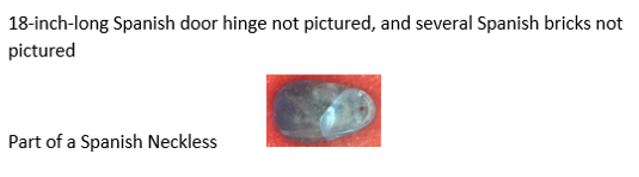
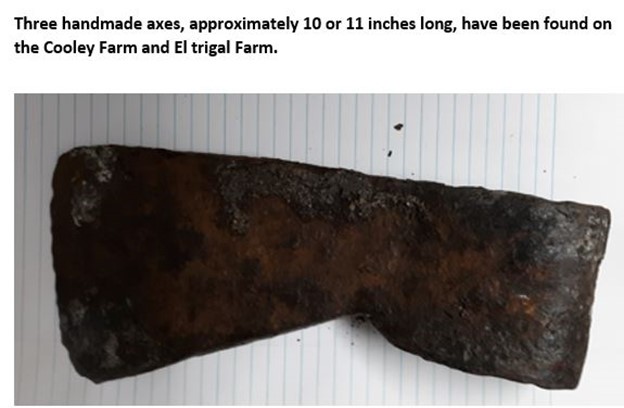
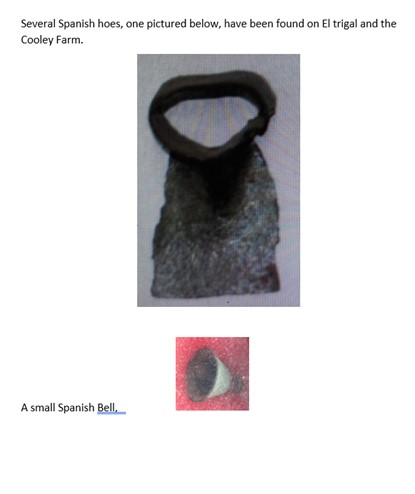
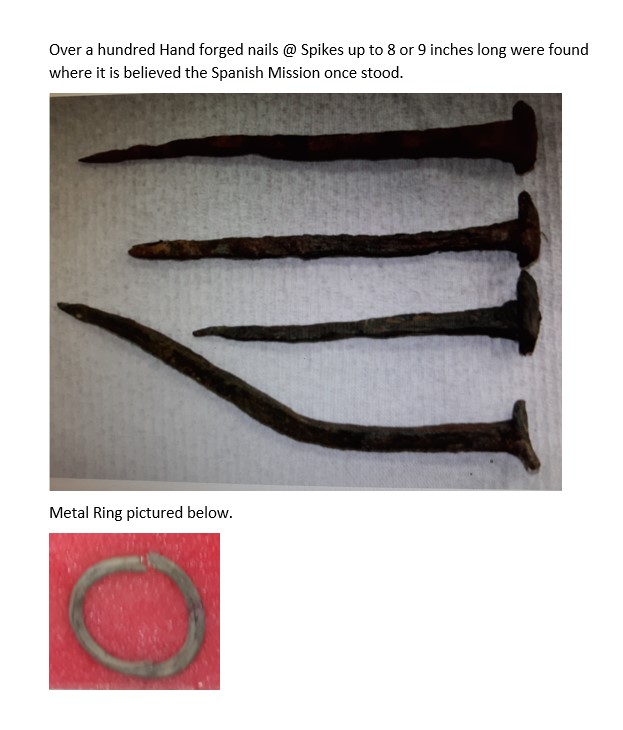
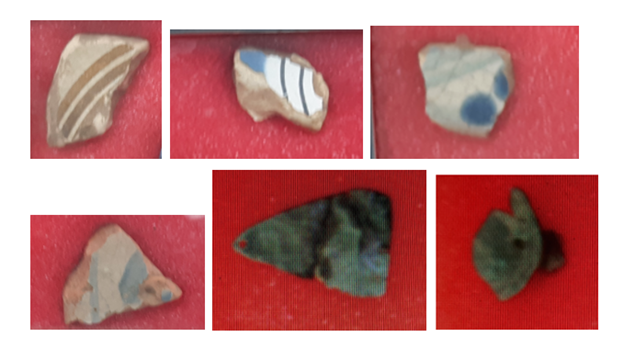
Numerous Spanish artifacts found on El trigal Ranch and the Bradley Cooley Estate document this was an advanced Spanish farming operation.
These Artifacts include Spanish axe heads, Spanish metal hoe’s, pottery, nails, hand forged hinges, pendants, beads, 54 brass bells, etc.
Numerous pieces of Spanish pottery sherds have been recovered on El trigal Ranch, the Bradley Cooley Estate, and the Finlayson property. Some of these pottery sherds are displayed on the following page.
My oldest Daughter, Mary Anne Folsom, owned 40 acres on the east side of the Aucilla River where the Apalachee Mound of Aisle is located. The town of Aisle is mentioned by the Scribes who wrote the daily narratives of Hernando de Sotos expedition as a Apalachee town they visited before crossing a river where they met great resistance.
According to the 1640’s Spanish records the Apalachee Natives from Aisle helped work the crops and livestock on the Governors Hacienda. The 40 acres of Aisle is presently owned by Tall Timbers and is being placed in a Conservation Easement to permanently protect the Mound. We will now review the El trigal Cattle Program.